Blog · May 26, 2026 · 6 min read
Confirmation Bias in Business: How Your Beliefs Shape What You See
By Doreen Milano, CPC
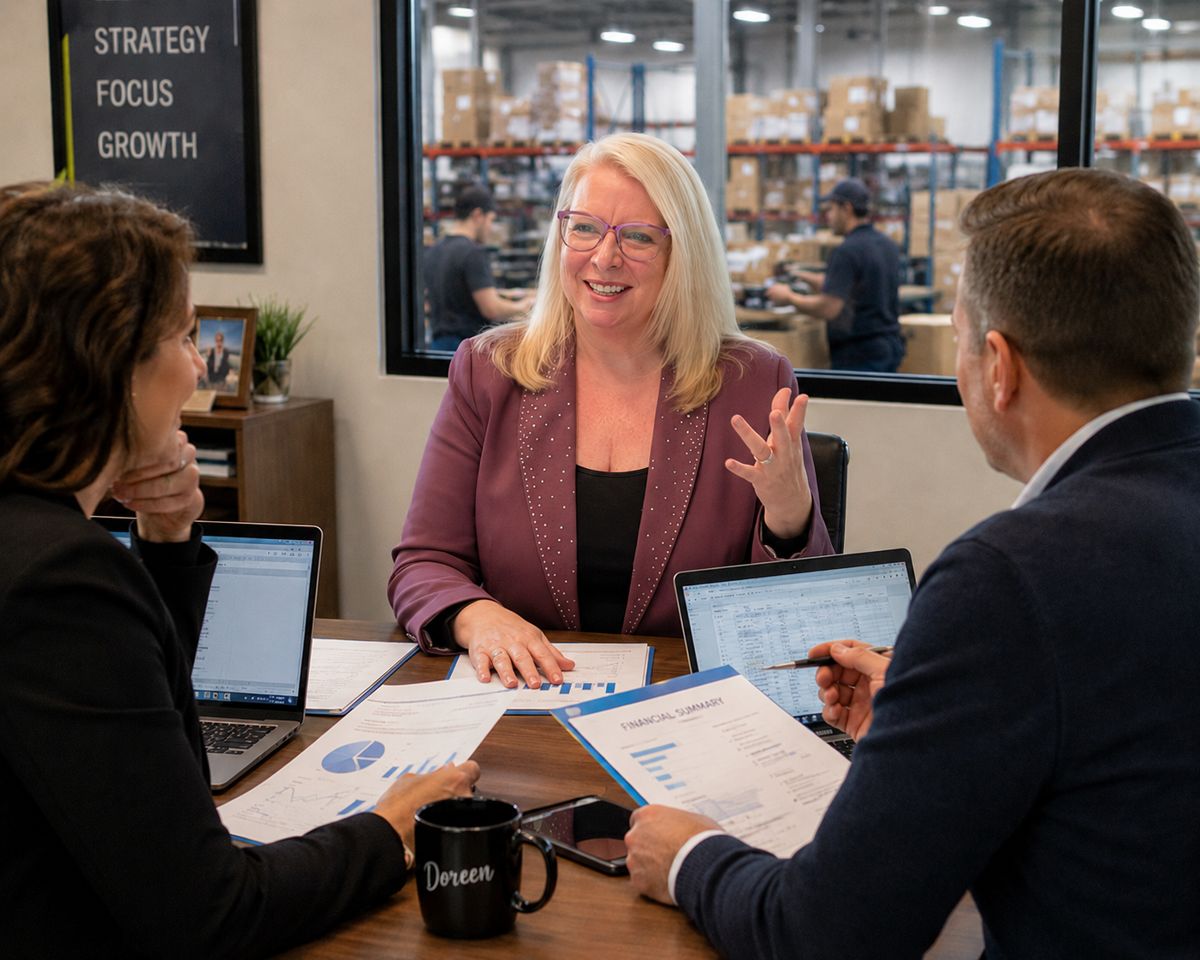
A service-business owner with a thirty-five percent close rate is sitting across from me, telling me she is not good at sales. The industry average for her service is closer to twenty percent.
She is not lying about her experience. She is filtering. The belief that she is not good at sales is telling her brain which evidence to notice and which to walk past. When I ask her where the belief came from, she talks about a prospect from two weeks ago who did not sign, a follow-up email that went unanswered, a referral that went cold. She does not mention the four contracts she closed in the same two weeks.
I have been a business coach for over fifteen years, working primarily with small and family-owned service businesses. Before that, thirty+ years in corporate as a controller, CFO, and CEO, including Fortune 100 work. The pattern this owner is running is the most common pattern I see in stuck businesses. The owners who get stuck rarely have an evidence problem. They have an attention problem. The evidence is there; they are not seeing it because their belief has decided what is worth seeing.
That is confirmation bias, and it is one of the most expensive forces in a small business.
What is confirmation bias in business?
Confirmation bias in business is the tendency to notice information that confirms what you already believe and to walk past information that contradicts it. It is not a character flaw. It is how the brain works.
Your brain does not passively receive information. It actively predicts what it will see, based on prior experience and on whatever you currently believe. When the world matches the prediction, the brain processes it efficiently. When the world contradicts the prediction, the brain has to work harder. So the brain economizes. It nudges your attention toward the evidence that fits and lets the rest drift past unnoticed.
The classic illustration is the invisible-gorilla experiment. Subjects watching a basketball game and counting passes routinely miss a person in a gorilla suit walking across the court. The gorilla is, for them, invisible. Not unobserved. Invisible. The same mechanism runs in your business every day. The owner, who is watching for threats, notices threats and is functionally blind to the opportunities walking through the same room.
In business, that mechanism shows up as selective memory of which deals closed and which did not, which feedback you took seriously and which you dismissed, which markets you pursued and which you decided were too hard. Over time, your business strategy gets built out of evidence you noticed, and not out of evidence you saw.
This is the work the PASSPORT method calls Step 6.
How does confirmation bias limit small business growth?
Confirmation bias limits small business growth by creating self-fulfilling prophecies. The mechanism is a loop, and it runs whether you are paying attention to it or not.
The loop goes like this. You hold a belief — clients are hard to find, I am not good at sales, the market is shrinking. The belief tells your attention what to notice, and your attention obliges. You notice the rejections, the cold referrals, the slow weeks. You interpret ambiguous responses (a prospect who takes three days to reply) as confirmation. Your behavior shifts in response — you push less hard, you follow up less consistently, you are quieter on the phone. Your results dip. The dip confirms the belief. The loop tightens.
The owner I described in the lede was inside that loop. She was about to make a hiring decision (bring in a salesperson at significant cost) on the basis of a belief her own numbers contradicted. The salesperson would not have been the wrong move in the abstract, but the reason for hiring would have been wrong, and the wrong reason produces the wrong scope and the wrong expectations.
We did not hire the salesperson. We started with the evidence log instead. By the end of the next quarter her close rate had risen another six points, because changing what she noticed changed how she behaved on the next call.
How do you break confirmation bias as a business owner?
You break confirmation bias by deliberately seeking the evidence that contradicts your belief. The process is short, and it has four steps that hold up across people, markets, and strategies.
Step One: Name the belief. Write it down. Pick the most operational version of it you can. Not I am bad at business; that is too broad to test. I am not good at sales or my clients are price-sensitive or referrals do not work in my industry — those are testable.
Step Two: Notice the filter for one day. Catch yourself in the act of attending to the confirming evidence. The first time you do this it is uncomfortable, because the filter is invisible until you are looking for it. The second day it is easier. By the end of the week you can name the moments where your attention narrowed.
Step Three: Actively seek disconfirming evidence. Look for examples that contradict the belief. Talk to peers who are succeeding in the area you have decided is impossible. Read the case studies. Pull the numbers from your own data. The evidence is rarely missing; it is just unindexed.
Step Four: Reframe. When the disconfirming evidence accumulates past the point where the original belief can hold, write a new belief — one that the evidence supports.
The tool that makes the four steps repeatable is the evidence log. One sheet, two columns. The limiting belief on the left; the disconfirming evidence on the right. You update it weekly. That is the whole tool.
The owner I described kept an evidence log over four weeks. In the disconfirming-evidence column she captured: she had closed nine of twenty-two prospects in the period (a forty-one percent close rate); her average deal size was eighteen percent above the industry average; three clients had told her unprompted that they had chosen her because the value was clear; her close rate had improved from twenty-two percent to forty-one percent over the prior six months. By week three, she had stopped writing I am not good at closing at the top of the page. She had replaced it with I am developing my closing skills, and the trend is up. The new belief did not change the underlying skill. She had been good at closing the whole time. It changed what she noticed, which changed how she behaved on the next call, which changed her close rate over the next quarter.
The four steps look small. The cumulative effect over a few months is large.
The owners who audit their beliefs see opportunities the filter has been hiding
The opportunities most family businesses miss are not absent. They are filtered out.
The belief filter has decided in advance what is and is not possible, and the filtered-out possibilities never reach the strategy table. An owner can run the same business with the same numbers for years and never see the segment that was clearly underserved, the price increase the market would have absorbed, the team member who was ready for more. Not because the data was missing. Because the data was being preprocessed by a belief that decided in advance what was worth attending to.
The audit interrupts the filter long enough for the missed opportunities to become visible. Most owners who run the audit find at least one belief that does not survive its own evidence. That is the belief worth working on first.
If you suspect your beliefs about your business are filtering what you see, the simplest first step is to write the belief down and start looking for the evidence against it. The harder step is doing it consistently for a month. That is where coaching helps.
If you want to talk through what your evidence log might look like, or which belief is most worth testing first, reach out.
Ready to Build Your Business With Purpose?
If you want to have a conversation about where your business actually is, where you want it to go, and why it matters, let’s talk.
Doreen Milano, CPC is the founder of Visions to Excellence and the creator of the PASSPORT method for strategic planning in small and family-owned businesses. She hosts Big Ideas Small Business on the OBBM Network.